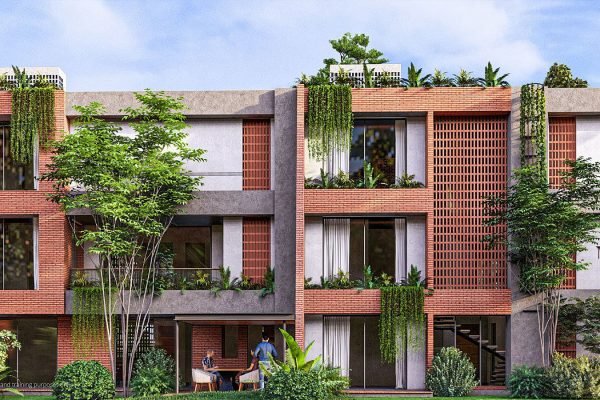
What a buyer actually owns differs fundamentally in an Embassy Astra vs White Lotus Amanvana comparison. At Embassy Astra you acquire a defined saleable area within a tower plus an undivided share of common land. At White Lotus Amanvana you acquire a plot, the house built on it, and roughly 5,000 square feet of undivided land share. Over a long hold, that distinction shapes value differently.
Undivided Share Versus A Plot You Can Point To
Embassy Astra’s ownership structure is standard apartment tenure. Buyers acquire built-up area within one of four G+23 towers, together with an undivided share in the land and common assets: the 2.4-acre vehicle-free podium, the clubhouse, two basement levels and the sports and wellness zones. Resale liquidity in this format tends to track brand and location rather than individual unit configuration, and both favour the address given its adjacency to the fully sold-out Embassy Lake Terraces.
The Embassy Astra vs White Lotus Amanvana difference is tenure, not just format. Amanvana conveys something more tangible. Each of the 95 villas sits on a plot of roughly 2,400 square feet with an undivided land share of around 5,000 square feet, materially higher than apartment products in the same micro-market. The project’s own material identifies this as the most durable asset characteristic over a ten-year hold, and the reasoning is sound: approved villa land within the airport corridor is structurally finite, whereas built area can always be added vertically elsewhere.
Carpet Efficiency Separates The Two By Thirteen Percentage Points
Efficiency is where the Embassy Astra vs White Lotus Amanvana formats diverge most measurably. Embassy Astra publishes 71% carpet-to-sale efficiency across the project, which is high for the high-rise luxury segment and the reason its internal dimensions read generously. Carpet area measures 1,756 square feet on the 3 BHK Large and 2,089 on the 4 BHK, against saleable areas of 2,469 and 2,936 respectively.
Amanvana runs approximately 84%, which the project describes as exceptional even within the villa segment. On a 4,000 square foot Vaayu that translates to roughly 3,360 square feet of carpet. The RERA filing records carpet buckets ranging from about 3,017 to 3,296 square feet across the 95 units. The gap reflects construction format rather than developer generosity, since a low-rise villa loads far less common area, lift core and corridor into its saleable figure than a G+23 tower must.
Internal Planning Reflects Two Quite Different Household Assumptions
Embassy Astra plans for vertical family life within a single level. Minimum bedroom width holds at 12 feet in every configuration, floor-to-floor height reaches 3.4 metres with a 2.9-metre false ceiling in living and bedroom areas, and living-dining decks run six feet deep, stretching to nearly 20 feet in the 3 BHK Large. Every apartment opens off a 2.5-metre lobby, with fire and service lifts on a separate core so staff, deliveries and refuse never cross resident circulation. A staff suite with its own entrance is standard.
Amanvana plans across three levels instead. The Vaayu variant leads with a sky-lit master suite, an entertainment deck and gardens at multiple levels, aimed at buyers who want elevated views and separation between social and private floors. Bhoomi is ground-centric, with a 250 square foot private lawn, larger bedrooms, wraparound garden views and servant quarters. Both include a private elevator sized for a wheelchair and an attendant, which is unusual provisioning and matters for multi-generational households.
Outdoor Space Is Shared At One And Private At The Other
Embassy Astra’s open space is communal by design. Roughly 75% of the 10.5-acre parcel stays open, with all four towers positioned along the southern edge in a staggered linear arrangement that frees the entire northern half as one continuous green amenity band. A nature-play stream threads the central podium, landscaped islands break up the pool ensemble, and 2.4 acres of ground level stay free of vehicles. Every resident shares all of it.
Amanvana splits its roughly 70% open area between shared and private. Villas sit in staggered micro-clusters of two to three around courtyards, connected by shaded landscape trails and a continuous green spine, with about 6,348 square metres given to parks and tree planting. Each villa additionally holds its own backyard, terrace gardens and, in Bhoomi, a private lawn. Weighing Embassy Astra vs White Lotus Amanvana on outdoor space therefore means choosing between more communal landscape and some genuinely private ground.