The most useful frame for MAIA The Seven vs White Lotus Amanvana is not price but format. One offers a 4 BHK apartment on an upper floor of a 32-storey tower; the other offers a three-level row villa with its own plot and garden. Both are 4 BHK only, both sit at roughly 70 per cent open space, and both are registered with RERA. What a buyer owns, and how they live, differs considerably.
Understanding what you actually own in an apartment or villa
An apartment purchase conveys the unit plus a proportionate undivided share in the land beneath the building. At The Seven, 128 homes share a 3.7-acre parcel, so the per-home land component is modest by design and the value sits in the built asset, the floor level and the view. A villa purchase at Amanvana conveys roughly 5,000 sq. ft. of undivided share per home alongside a built villa of about 3,900 to 4,000 sq. ft. on a 2,400 sq. ft. plot. Over a long hold, land share behaves differently from built area, since structures depreciate and land does not. That distinction sits underneath almost every other difference between these two projects. The practical question is which of those two components a buyer wants their capital weighted toward.
How the high-rise condominium format works at MAIA The Seven
The Seven’s format is vertical. Two connected G+32 towers hold 128 residences of 4,419 to 4,950 sq. ft., each with a family room, study and independent staff suite with separate entry. Planning emphasises no common walls and more than three open sides per home, with deep wraparound balconies. Height opens up views across the low-rise Basavanagudi heritage skyline, which the surrounding built fabric structurally protects. The amenity stack reflects the format too, with more than 100,000 sq. ft. across two clubs and 50-plus features, since a tower footprint frees podium and ground area for shared facilities rather than private gardens. The format also places structural maintenance with a single owners’ association covering both towers, funded through a common corpus that every household contributes to.
How the low-rise row villa format works at White Lotus Amanvana
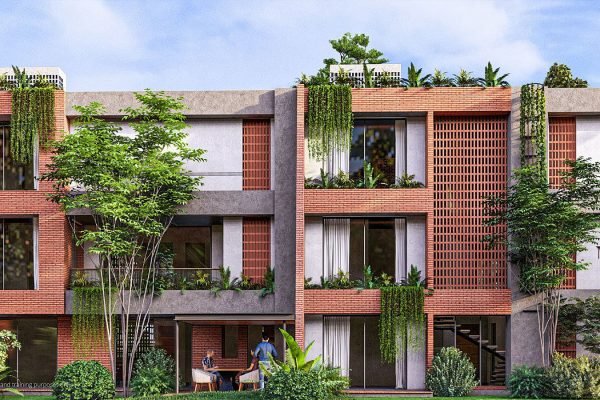
Amanvana’s format is horizontal. Ninety-five Ground+2 row villas sit at 7 homes per acre across about 14 acres, in staggered clusters of two or three around courtyards, with a pedestrian-first internal layout. Two variants share the same plot footprint: Vaayu at roughly 4,000 sq. ft. leads with a sky-lit master suite and entertainment deck, while Bhoomi at about 3,900 sq. ft. adds a 250 sq. ft. private lawn and wraparound garden views. Every villa includes a private lift sized for a wheelchair, three car parks and servant quarters. The design follows the Balinese principle of Karang Jalananda, pairing personal space with the flow of water through streams and lagoons. Row villa construction means each home shares side walls with its immediate neighbours while remaining open above and below.
Deciding points in MAIA The Seven vs White Lotus Amanvana
- Entry price: ₹6.5 crore at Amanvana against ₹13.5 crore at The Seven.
- Rate per sq. ft.: roughly ₹16,250–17,500 against approximately ₹29,000, both on saleable area.
- Land share: around 5,000 sq. ft. of undivided share per villa; a proportionate share of 3.7 acres per apartment.
- Open space per home: roughly 4,300 sq. ft. at Amanvana; about 880 sq. ft. at The Seven.
- Clubhouse per home: around 780 sq. ft. at The Seven; approximately 260 sq. ft. at Amanvana.
- Vertical access: private in-villa lift at Amanvana; shared high-speed passenger and service lifts at The Seven.
- Commute orientation: airport and aerospace cluster in the north; CBD and metro in the south.
These points rarely align in one direction, so most buyers find one or two of them decisive rather than the whole list.
Trade-offs worth understanding before choosing between these two formats
Each format carries a cost attached to its own strength. A villa gives land share, ground-level garden and no shared walls above or below, but spreads maintenance across only 95 households and places the community 40 km from the city centre with metro access still proposed. An apartment gives height, view protection, a much larger shared amenity base and three operational metro stations nearby, but the land component is small and peak-hour egress from Basavanagudi’s dense core is slow. Both projects target late 2030 or early 2031 possession, so either choice is a long-horizon commitment rather than a near-term move. Comparing MAIA The Seven vs White Lotus Amanvana on format alone will not settle the question, since the corridors behind them differ as much as the buildings do.